
By Kneebar News
A fighter winces after an alleged eye poke. You have a nanosecond to respond.
Here are some options:
- Trust the fighter and give her 5 minutes to recover
- Rely on your own observations. Was it a finger or a knuckle? Mild or severe?
- Summon the ringside doctor
- Ask to see an instant replay
- Crowdsource it. Did the audience jeer the complainer, or grimace in sympathy?
- Poke yourself in the eye and call it a day
Now it’s time to deal with the aggressor. Is a warning enough? Should you deduct a point?
High-profile UFC refs can earn a very good living. But cash can’t insulate them from the pressures of making instantaneous rulings in front of commentators, reporters, UFC brass, and millions of La-Z-Boy scolds poised to second-guess them.
Following are 7 problems of MMA reffing:
- Eye Pokes. See above.
- Groin strikes. A fighter takes a teep kick near the beltline and casts a pleading look at the referee. Maybe he’s truly hurt. Maybe he’s faking it in hopes of banking some sympathy from the ref, or of getting some time to recover from a grueling grapple. Who knows for sure? No one, really. A ringside doctor wouldn’t dare examine the fighter’s huevos in front of 20,000 fans. And video replays can’t gauge pain. In reality, only the fighter knows if his eggs were cracked, so a ref is left to guess.
- Accidental fouls. When was the last time you heard an MMA ref call a foul “intentional” rather than “accidental”? Probably never. After all, it’s tough to gauge a fighter’s intent. And the consequences of calling a foul intentional – such as disqualification, or a 2-point deduction – can put a ref in the queasy position of single-handedly changing a fight’s trajectory. That’s the problem with a binary system. So here’s a suggestion: allow refs to call a foul “negligent.” Dan Miragliotta might have appreciated that option at UFC 172, when light-heavyweight champ Jon Jones eye-poked challenger Glover Teixeira twice. Instead, Big Dan chose to play it safe. “Jon, don’t make me take a point. Watch your fingers. Please,” he pleaded after the second poke. But Jones continued parrying with outstretched fingers. UFC commentator Joe Rogan expressed concern. “Jon has gotta stop reaching out with open hands like that,” Rogan said in a later round. “He keeps doing it, and Dan Miragliotta is not warning him.”
- Safety vs. Second Chances. A fighter is getting pummelled into the afterlife. Should the ref declare a TKO, or let the concussioning continue? It’s not like roasting a turkey; there’s no pop-up timer to tell you when a fighter is cooked. Consider two contrasting examples. In the main event at UFC 125 in 2011, challenger Gray Maynard nearly bludgeoned lightweight champ Frankie Edgar into retirement during a brutal 10-8 first round. (Review the gory details here). But ref Yves Lavigne didn’t intervene. That decision freed Edgar to miraculously fight his way back to a 5-round split draw in a battle the World MMA Awards later voted Fight of the Year. “What a warrior,” announcer Mike Goldberg gushed. Now compare that to UFC Fight Night 125 in 2018, when ref Mario Yamasaki let flyweight contender Valentina Shevchenko rain down roughly 100 unanswered strikes on the head of a helpless Priscila Cachoeira. “I allowed [Cachoeira] to be a warrior,” Yamasaki said later in his own defense, echoing Goldberg’s word choice from seven years earlier. But UFC president Dana White, as bloodthirsty as any fan, called the Brazilian ref “disgusting” and permanently banned him from the Octagon. The lesson for refs? The MMA ecosystem is fickle.
- Separations. Two fighters stand paralyzed against the cage, or Krazy-Glued to the ground in full guard. Minutes pass, and a takedown, submission or TKO seem about as likely as Pete Peterson giggling. Should the referee defer to self-anointed purists like Rogan by doing nothing, or revive drowsy fans by separating the fighters? The Unified Rules of Mixed Martial Arts are pretty clear: stand ’em up. But the Rules are silent on a time frame, so refs don’t know whether to wait 30 seconds or 3 minutes.
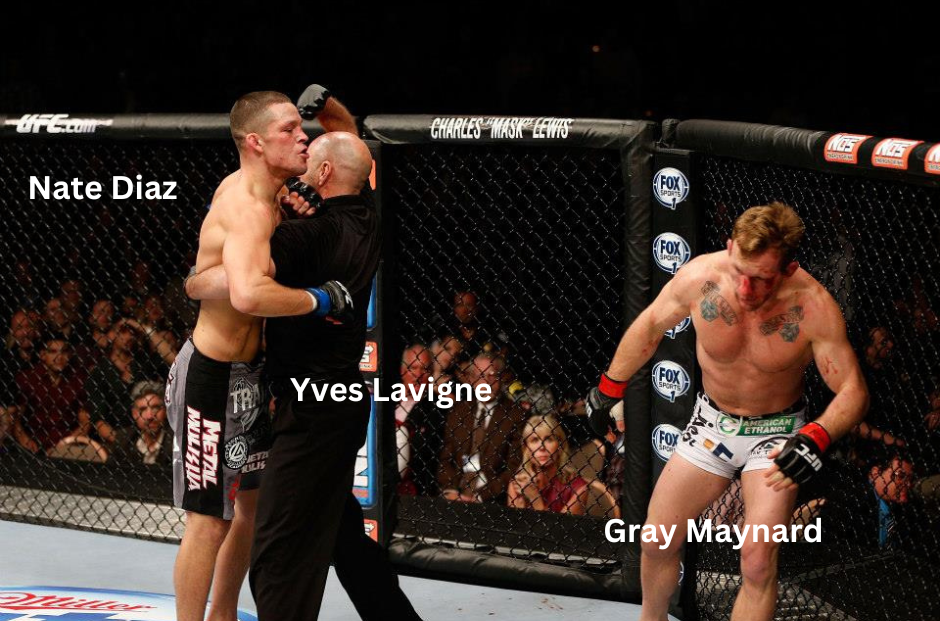
- Inconsistency. Unpredictable officiating drives us nuts. But to MMA refs, the Unified Rules are as open to interpretation as the U.S. Constitution is to lawyers. Remember the Gray Maynard vs. Frankie Edgar battle from 2011, when ref Yves Lavigne let the fight continue even though Edgar was practically on life support? Just 2 years later, in a 2013 matchup between Maynard and Nate Diaz at the TUF 18 Finale, the very same Yves Lavigne stopped the fight and declared Diaz the winner by TKO even though Maynard was still on his feet.
- Human factor. Refs aim to be fair. It’s their job. It’s also an impossible standard. Why? They’re human. It’s no surprise that a ref might prefer one fighter to another, favor their countryman over a foreigner, get caught up in the excitement of a raucous crowd, or hope for a quick finish so he can get home and kiss his kids goodnight.
Seven problems. If only we could offer 7 solutions.
# # #

(Click here to see video)